

We’re here to answer all your evacuation chair questions, read on to find whether you need evacuation chairs, and how to prepare for emergency stairway evacuation in your building.
Speak to our evacuation specialists today to quickly understand the right Exitmaster solution for your building and compliance needs.
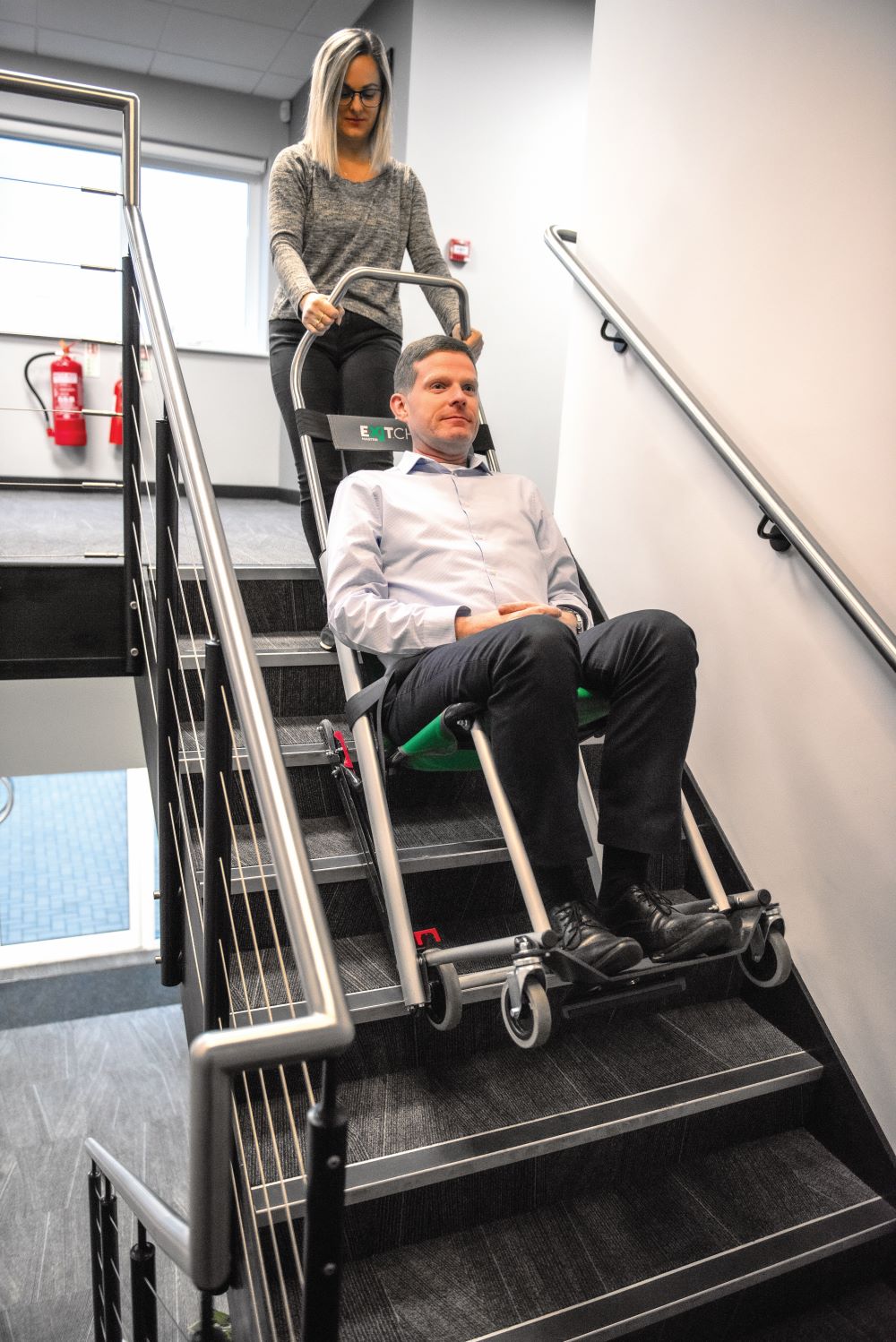
An evacuation chair is a chair designed specifically to evacuate persons with disabilities in an emergency. Evacuation chairs are usually designed for going downstairs, however, for basements or floors below ground level you can also get evacuation chairs for upstairs travel. A common scenario is using an evacuation chair for a wheelchair user: the wheelchair user would be transferred to the evacuation chair, to be taken downstairs, and to an area of safety outside the building.
It’s the legal requirement of the building tenant or owner to provide a safe means of escape for the building occupants – this is not the responsibility of the Fire Service.
If your building is open to the public, you will also be required to provide evacuation provisions for visitors. This is known as a General Emergency Evacuation Plan (GEEP). If you also have employees or residents with disabilities, you need to have a safe method of stairway evacuation for each person. This is known as a Personal Emergency Evacuation Plan (PEEP).
Disabilities can also be temporary, as well as long-term. If a resident or member of staff has a broken limb, for example, they may need assistance evacuating the building when they wouldn’t usually. Under UK fire safety expectations, evacuation planning must now consider individual needs through structured evacuation planning such as PEEP and GEEP documentation, ensuring solutions are suitable for each person’s circumstances rather than a one-size-fits-all approach.
This reiterates the importance of the GEEP, a pre-emptive measure for unforeseen circumstances.
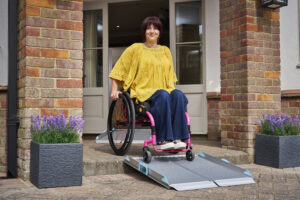
Evacuation chairs are only required for buildings with stairways, if your building doesn’t have stairways there will still need to be evacuation provisions and plans in place, but evacuation chairs won’t likely be required. In some situations, temporary access may still be required, so you can check our portable ramps to support safe and flexible movement where needed.
If you have a lift, visitors or staff with disabilities will use this to gain upper floors. However, lifts can’t be used in an emergency, so there needs to be a safe method of stairway evacuation provided.
For a general emergency evacuation plan, the typical guideline is one evacuation chair per staircase on each floor. This should be considered alongside any additional provisions required for regular occupants within the building.
Effective evacuation planning should also take into account individual assessed needs where applicable, particularly where Personal Emergency Evacuation Plans identify people who may require assisted evacuation support.
Incorrect placement or insufficient equipment coverage can significantly increase risk during an emergency, potentially impacting both operators and individuals requiring assistance.
Because every building is different, evacuation requirements should always be based on a tailored assessment of your layout, occupancy and risk profile.
Yes, there are evacuation chairs that can go upstairs. This is most commonly required for evacuating basements or floors below ground level. For manual evacuation chairs, there will usually be 2 or 4 operators needed to carry the loaded evacuation chair upstairs, this will be subject to manual handling requirements and the make and model of the evacuation chair.
Please note that not all evacuation chairs are designed to go upstairs, and this should be checked with the manufacturer.
Explore models such as the Versa Evacuation Chair, Versa Plus Evacuation Chair and Versa Elite Evacuation Chair, designed for enhanced manoeuvrability and multi-directional evacuation support in suitable environments.
These can be supported with additional options such as the Ego Evacuation Chair and Original Evacuation Chair, offering alternative solutions depending on building layout, user requirements and frequency of use.
Thankfully, emergencies in our buildings are not happening regularly, but this does not mean we can afford to skimp on our evacuation provisions. In an emergency, the last thing you need is an evacuation chair that is difficult to use for the operator and unsafe and uncomfortable for the passenger.
These chairs are life-saving equipment, it’s imperative you choose quality, safe, products that operators are confident to use.
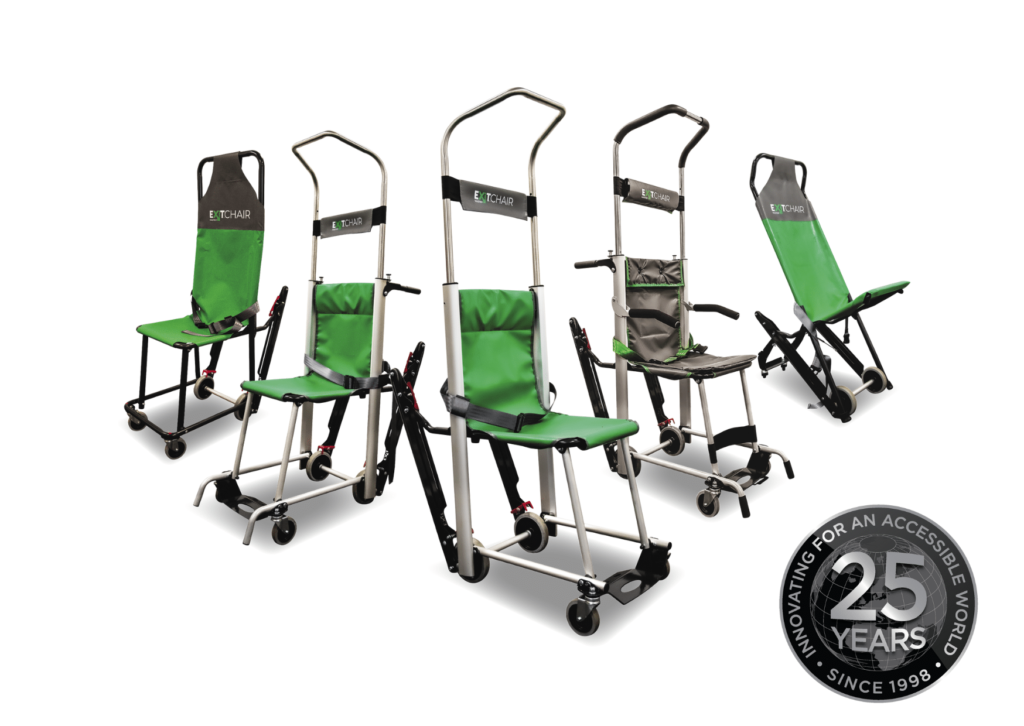
Our models are the safest, most comfortable, most ergonomic and easy to use on the market. But don’t just take it from us:
Fire & Evacuation Trainer ” I have always found Evacuation chairs difficult to use, but yours are so simple to use and you feel so safe when you are a passenger.”
International Safety Organisation Chairman ” As an international organisation with offices in multiple countries around the world, our sales teams have never found evacuation chairs easy to sell or demonstrate. That will change now with us introducing the ExitMaster range as they are quick, safe and extremely easy to use and demonstrate.”
Backed by 25 years of experience, Exitmaster are trusted industry experts who manufacture innovative evacuation chairs that provide the best experience for both operator and passenger.
We believe in making the experience as best as possible (given the circumstances) for the chair passenger, and this includes a more dignified experience. There are undignified evacuation methods such as ‘sledges’ or ‘mattresses’ that many staff or residents with disabilities would not like their colleagues or associates to see them using.
It’s important to ensure your staff and residents feel valued and respected, including providing a dignified means of evacuation in case of an emergency. For permanent accessibility improvements, you can also check our Permaramp relocatable external ramps designed for safe and reliable long-term access.
Contact us today to talk about your evacuation chair requirements.